How the Triangular Theory of Love Can Lead to Fulfilling Intimate Connections and Relationships8/23/2021 Author: Alejandra Hilbert  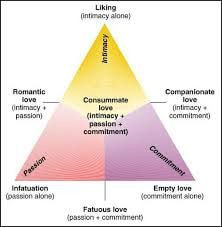 Psychologist Robert Sternberg proposed that there are three different building blocks which combine to form different types of love. These components are intimacy, passion, and commitment. Intimacy is defined as feelings of warmth, understanding, trust, support, and sharing. Passion is characterized by physical arousal and desire, excitement, and need. Finally, commitment is typified by feelings of permanence, stability, and the decisions to devote oneself to a relationship and to work to maintain it. Under Sternberg’s model, there are eight relationship types (as illustrated here). Utilizing Sternberg’s conceptualization of romantic partnerships, one can compare a romantic relationship to a stool. A stool only propped up by one leg is much less likely to support one’s weight, whereas a three legged stool could unwaveringly; thus, relationships with two or more of the critical components will lead to a greater sense of fulfillment, dependence, and security. Utilizing the stool metaphor, single leg relationships are those with only one building block. An example of this relationship structure is empty love, which describes a relationship where commitment is high, but there is little intimacy or passion—in essence, a work relationship. Conversely, a relationship which is high in passion but lacks intimacy and commitment is infatuation, or colloquially known as a crush. Intimacy, passion, and commitment are all absent in nonlove. Ideally, a strong dose of all three components should exist within the partnership, as typified by consummate love. Throughout the course of the relationship, there will likely be a shift in prevalence of particular blocks and how they appear. Passion may run high in the beginning of a new romantic relationship, as coined by the term new relationship energy (NRE). Sheer novelty adds excitement and energy to new loves. Once a relationship is established and novelty is lost, passion slowly subsides; typically the longer a relationship lasts, the less passionate it becomes. However, other components, like intimacy and commitment, are bolstered to maintain balance. Time alone does not cause intimacy, passion, and commitment to occur and grow, but rather deliberate effort is needed to foster these critical components if they do not initially exist in your partnership. Knowledge of this model of love may help couples avoid pitfalls in their relationship, allow for intentional work in areas that need improvement, or aid partnerships recognize when it may be time for a relationship to end. Sternberg asserts that reaching consummate love is often easier than maintaining it. Understanding that there is an ebb and flow in which building blocks may appear in our relationships, have are few recommendations on how to cultivate continuous consummate love:
Sources:
1 Comment
How to honor the individuals in the relationship through attachment styles and love languages12/18/2020  Author: Angellynn Lily Tam The words relationships and love are words heard throughout one’s lifetime. Often, the image that pops into our heads are scenes from movies, tv shows, and other media. The media’s portrayal of relationships has become our standard of what relationships and love are supposed to look and be like. We assume we find the one and live happily ever after. In actuality, relationships take work, but prior to working on the relationship as a couple, we first have to shift our focus and attention to acknowledge the two individuals that are in the relationship. We often forget that before getting into a relationship, we were once individual people who have decided to come together. In Dr. Keith Sutton's workshop for clinicians on Integrative Emotionally-Focused Couples Training, he teaches that we can honor the two individuals that choose to come together into a relationship by examining each person as their own part of the relationship. Each individual brings something unique to the table, and in order for a couple to work, we have to first understand each person and how each person shows and receives love. The first real connections we have are with our caregivers. As children, we are like sponges that soak up information all around us, even if we aren’t fully aware. The household in which we grow up plays a huge part in how one might show love to their significant other. The attachment styles one has are based on what we experience as children, primarily from our caregivers. If a child grew up around a parent who is abusive, that child may learn that it is normal behavior. This pattern of learnt behavior may continue into romantic relationships if it is not addressed. Identifying the characteristics of what is a healthy relationship versus unhealthy relationship are not taught, but learnt through observations and experiences. There are four different types of attachment styles: secure, anxious, avoidant-dismissive, and avoidant-fearful. Individuals with a secure attachment style are attuned with their emotions and are able to foster a safe, honest environment with their partners to speak out about upsetting topics. Individuals with anxious attachment style tend to struggle with their sense of self and romanticize about love with a positive view of their partner. Individuals with avoidant-dismissive attachment are emotionally distant from their partner and tend to suppress their feelings. Lastly, individuals with avoidant-fearful attachment style experience inner fluctuation of fear in being too close or too distant from their partners, which can lead to the relationship being volatile. It is important to note an individual’s attachment style when discussing behaviors within a relationship. Concurrent with attachment styles, it is also helpful to know individuals’ love languages. The different types of love languages are quality time, words of affirmation, receiving gifts, acts of service, and physical touch. Our love languages are how we tend to give, and wish to receive love. Knowing your partner's love language can help in understanding how to your partner shows love, and how to show love to your partner, and communicate how your partner can show love to you. So what does a healthy relationship look like compared to an unhealthy relationship? A healthy relationship is built around honesty, trust, mutual respect, and good communication. Self-esteem and self-confidence play a huge role in creating a safe space for both partners to be able to express their thoughts without judgement. There are many characteristics of an unhealthy relationship, but the main identifier of an unhealthy relationship is when one partner has more power over the other. This can lead to a potentially abusive relationship. With Emotionally Focused Couples Therapy (EFT), the focus is to develop the skills to be able to develop a secure attachment with their partner. This happens through understanding the cycle that gets in the way of each being able to communicate their love and care, and to be able to be responsive to each other. Often each partner loves their partner, and wants to connect, but the way that each tries to reach the other one, they end up missing each other. Relationships are not like in the movies, where they're all romance all the time and easy, but instead, it takes work to create a relationship that is fulfilling to each of the individuals, and make it the best relationship it can be. Through working on understanding our partners needs, our needs, and learning how to catch the cycle, we can strengthen our attachment bond, and have a relationship with a secure attachment, which is the foundation of true love.
Author: Florence Almquist Checa  Episode 81 of the podcast, “The Tapping Solution”, discusses ways in which we can set boundaries to have better relationships with ourselves and others. Nancy Levin, the host of this episode, begins by telling us that many of us are people pleasers. We need to learn to take ourselves into account just as much as we take others into account. We need to realize that we don’t have to do certain things. Nancy explains that it’s important to generationally heal forward and backwards by allowing ourselves the freedom that past generations didn’t. For example, women had to and still have to sacrifice a lot in order to become a mother, such as career and other personal goals whilst still being expected to maintain the household. The host delineates important symptoms that indicate you might need to create boundaries which include hardcore resentment and blaming everyone else around you for how you feel. Many women and men don’t want to be rude by setting boundaries. Nancy Levin explains that this behavior stems from conflict avoidance. When those of us avoid external conflict, we’re actually avoiding internal conflict. She highlights that this creates patterns of self sabotage. Nancy encourages us to understand that it is not our responsibility to manage the response of others. The problem she says is that some of us forget that we have a say about liking someone else, and only think about them liking us. Certain individuals are chasing external validation, which keeps them from setting boundaries. She encourages people to ask themselves, "what void you are trying to fill?".  So, how do we begin this journey? Nancy Levin suggests we ask ourselves, "what you have been tolerating and accepting that does not align with what you want?" Usually, we are the ones crossing our own boundaries, not others. She emphasizes that we enable our boundaries to be crossed. However, once we get in the habit of setting healthy boundaries, for example in dating, we no longer even attract those kinds of people anymore. Some examples of setting boundaries could be telling someone they are not comfortable having sex yet, or being upfront about not being able to make plans. Other examples could be bringing up things that have been bothering you and helping your friends fit your needs better. Nancy delineates that when we don't know our own boundaries, and instead acclimate ourselves to the other person's way of living, we have an important mechanism in which resentment builds. This tells us that something is wrong, and we need to reevaluate our approach. Not only do we have to know what we want, but also know what we don’t want. Nancy Levin emphasizes that it is often very hard for people to say “no.” A useful strategy is if you can’t say no, to tell the person that you will get back to them. We need to prevent ourselves from doing the “knee jerk yes.” The only reason we should say “yes” is when it’s a desire. Life should not just be these situations in which you just have to “deal.” We have more agency than we think we do. Nancy underscores that some of us often override our own integrity for the high and the pleasure that comes from the other person trusting us and wanting us when the high should come from respecting our own integrity first. What about when you really love the person? Oftentimes, many individuals love to be needed by those they love very much. Nancy pushes these individuals to realize that packaging themselves and trying to please that person actually takes so much more energy than honoring their own boundaries. She emphasizes that the goal is to have a true relationship with that person that you love. They will be thankful that they now know ways they can love you better. We need to begin showing up for ourselves. Source: https://www.thetappingsolution.com/notes/
|



 RSS Feed